Deforestation · 2001–2025
Deforestation in Laos
Since 2001, Laos has lost about 5.4 million hectares of forest (about 54,000 km²): 28% of the forest it had in 2000. Most of it was lost to shifting farming, so much of it can grow back. About 2.09 million hectares (39%) was deforestation: forest cleared for good for farms, mines or towns.
- Forest in 2000
- 19.1 million ha
- Forest lost since 2001
- 5.4 million ha28% of it, about 54,000 km²
- Cleared for good
- 2.09 million hadeforestation, 39% of the loss
- Worst year
- 2023445,000 ha lost
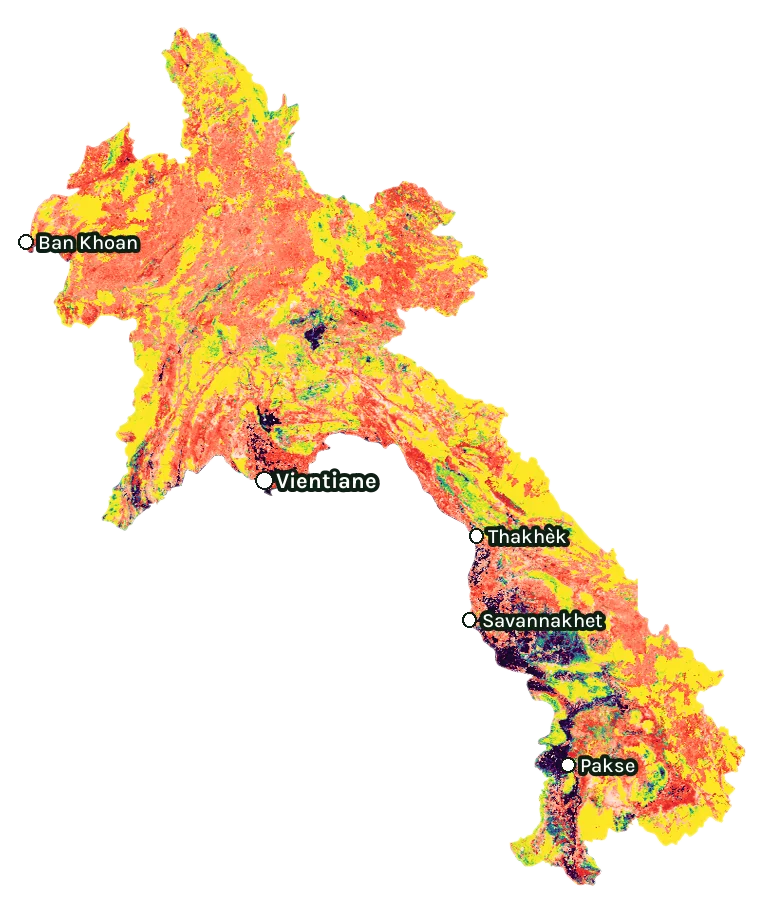
Map
Where Laos has lost forest
Every square kilometre of Laos as satellites saw it from 2000 to 2025. Yellow and green were forest; red to white marks where it has been lost since 2001, and when.
- Forest cover in 2000
- 0%25%50%75%100%How much of the land was forest: dark purple had little or none, yellow was dense forest.
- Year the forest was lost
- 200120132025Where forest was cut down, burned or cleared since 2001: red for the early years, through orange, to white for the most recent. Solid where a fifth or more of a place's forest went, fainter where 8% or more did.
- Cities
- The capital (the larger dot) and the biggest cities, to help you find your way.
Year by year
Forest lost in Laos, year by year
Forest loss has stayed about the same: about 333,000 hectares a year in 2021–2025, against 351,000 hectares a year in 2016–2020. The worst year was 2023, when about 445,000 hectares of forest were lost.
Hectares of forest lost each year
Show the figures as a table
| Year | Cleared for good | Can grow back | Total |
|---|---|---|---|
| 2001 | 17,400 ha | 19,100 ha | 36,500 ha |
| 2002 | 26,400 ha | 29,600 ha | 56,000 ha |
| 2003 | 32,000 ha | 55,100 ha | 87,100 ha |
| 2004 | 31,700 ha | 32,600 ha | 64,300 ha |
| 2005 | 27,600 ha | 40,700 ha | 68,300 ha |
| 2006 | 57,700 ha | 65,300 ha | 123,000 ha |
| 2007 | 69,900 ha | 63,400 ha | 133,000 ha |
| 2008 | 43,300 ha | 37,300 ha | 80,700 ha |
| 2009 | 77,100 ha | 68,800 ha | 146,000 ha |
| 2010 | 73,400 ha | 94,200 ha | 168,000 ha |
| 2011 | 74,200 ha | 57,000 ha | 131,000 ha |
| 2012 | 71,000 ha | 76,800 ha | 148,000 ha |
| 2013 | 64,500 ha | 141,000 ha | 206,000 ha |
| 2014 | 81,000 ha | 163,000 ha | 244,000 ha |
| 2015 | 88,300 ha | 197,000 ha | 285,000 ha |
| 2016 | 121,000 ha | 268,000 ha | 389,000 ha |
| 2017 | 105,000 ha | 244,000 ha | 349,000 ha |
| 2018 | 98,800 ha | 196,000 ha | 294,000 ha |
| 2019 | 128,000 ha | 236,000 ha | 364,000 ha |
| 2020 | 125,000 ha | 233,000 ha | 358,000 ha |
| 2021 | 121,000 ha | 196,000 ha | 318,000 ha |
| 2022 | 142,000 ha | 179,000 ha | 321,000 ha |
| 2023 | 187,000 ha | 258,000 ha | 445,000 ha |
| 2024 | 145,000 ha | 206,000 ha | 351,000 ha |
| 2025 | 86,500 ha | 143,000 ha | 229,000 ha |
The satellite method improved in 2011, so compare recent years with each other rather than with the 2000s. Hover over or tap a year for its figures.
Causes
What is causing deforestation in Laos?
- 39%cleared for good (deforestation)
- 61%can grow back (fire, logging, storms)
- Shifting farming60% · 3.24 million ha
Can grow back. Small patches cleared to grow crops for a few seasons, then left to grow back.
- Farms, pasture and plantations37% · 1.97 million ha
Cleared for good. Forest cleared for crops, cattle pasture or tree plantations: the biggest cause of deforestation in the world.
- Mining and energy2% · 109,000 ha
Cleared for good. Forest cleared for mines, oil and gas, power lines and dams.
Also, each under 1%: logging, towns and roads, storms, floods and other natural causes, wildfires, unknown causes.
Causes for 2025 are estimates, based on what caused forest loss in the same places up to 2024.
Is all forest loss deforestation?
No. When forest is cleared for farms, mines or towns, it is gone for good: that is deforestation. When it is logged or burned, it usually grows back. We count both as forest lost, but only the first as deforestation, so a country with a bad fire year isn't shown as clearing its forest for good.
Cities that lost the most forest around them
Forest lost within 10 km of each city centre since 2001.
| City | Forest lost | Share of its forest | Cleared for good |
|---|---|---|---|
| Thakhèk | 3,790 ha | 31% | 3,200 ha |
| Ban Khoan | 2,980 ha | 31% | 2,490 ha |
| Savannakhet | 2,270 ha | 43% | 2,270 ha |
| Pakse | 497 ha | 9.9% | 490 ha |
| Vientiane | 263 ha | 53% | 262 ha |
Frequently asked
Questions about deforestation in Laos
How much forest has Laos lost since 2001?
Since 2001, Laos has lost about 5.4 million hectares of forest (about 54,000 km²): 28% of the forest it had in 2000. Most of it was lost to shifting farming, so much of it can grow back. About 2.09 million hectares (39%) was deforestation: forest cleared for good for farms, mines or towns.
Is deforestation in Laos getting worse?
Forest loss has stayed about the same: about 333,000 hectares a year in 2021–2025, against 351,000 hectares a year in 2016–2020. These are five-year averages from 2011 on, the years the satellite maps were all made the same way.
What is causing deforestation in Laos?
The main causes of forest loss since 2001 are shifting farming (60%), farms, pasture and plantations (37%), mining and energy (2%). About 2.09 million hectares was deforestation, meaning forest cleared for good for farms, mines or towns. Causes for 2025 are estimates, based on what caused forest loss in the same places up to 2024.
What was the worst year for forest loss in Laos?
The worst year was 2023, when about 445,000 hectares of forest were lost.
How is forest loss measured?
We use satellite maps from the University of Maryland (Hansen and colleagues) that show, for every 30 × 30 m patch of land on Earth, the year its trees were cut down, burned or died, from 2001 to 2025. We add up those patches in Laos, counting only places that were at least 30% covered by trees in 2000. The cause of each loss comes from a map made by the World Resources Institute and Google DeepMind. All figures are estimates.