City report · West Bengal, India
Kolkata Air quality today
Air quality in Kolkata currently reads AQI 87 (Moderate): Unusually sensitive people should consider limiting long outdoor exertion.
AQI 87
Air quality right now
Moderate
- PM2.5, fine particles (µg/m³)
- 28.4
- tree cover
- 28.7%
- trees in this area
- 90.0K
- more trees needed
- 4.1K
Measured across a 2 km radius around Lebutala, Bowbazar, Kolkata, West Bengal, India (12.57 km²), from a satellite image of Oct 25, 2026. Lower AQI is better: 0–50 is Good, above 300 is Hazardous.
Kolkata · AQI 87 (Moderate)
Kolkata's tree count comes to 89,983 trees across 12.54 km² of land, 1 points below the 30% tree-cover level considered healthy for this area, so roughly 4,076 more trees would close the gap.
Air quality detail
Air quality in Kolkata today: AQI 87, Moderate
Main pollutant: PM2.5 · Observed Nov 11, 20:45 local time via OpenAQ ground stations, US EPA index. Values in µg/m³.
Ground station · Fort William, Kolkata - WBPCB, 2.2 km away · median of 10 stations
Health signal
Unusually sensitive people should consider limiting long outdoor exertion.
PM2.5
28.4
PM10
63.9
NO₂
71.7
O₃
15.5
SO₂
14.2
CO
0.8
Data: OpenAQ · CPCB, Central Pollution Control Board, Government of India (GODL-India)
- Outdoor exercise
- Fine for most people; unusually sensitive people should take long or hard exercise easier
- Windows
- Fine to open; close them if you are sensitive to pollution
- Mask
- Not needed for most people
- Air purifier
- Worth running if you are sensitive
Over the last 7 days, the CAMS air-quality model put Kolkata's daily AQI at 175 on average, from 128 on Nov 11 to an hourly peak of 246 on Nov 8.
This is the US EPA AQI. How it differs from India's AQI (CPCB) · The full guide
Where Kolkata stands: the most polluted cities in the world right now · the cleanest
City air guide
Why is Kolkata's air so bad in winter?
Right now
- Today's AQI in Kolkata is 87, moderate, mostly from PM2.5.
- Over the past 7 days, the daily average was 175.
- November is in Kolkata's usual season for winter particle pollution (October to February), so expect bad days to come and go until it ends.
Kolkata's air is usually at its worst from October to February [3]. In winter, colder air and weaker winds leave pollution close to the ground across the Indo-Gangetic Plain [6], and winter winds from the north line the city up with pollution sources upwind [5]. Burning of wood, leaves and rubbish adds smoke that makes the fine particles more harmful [2][3]. In winter 2025-26, fine particle levels in the city averaged 78 µg/m³, about twice India's national standard [1].
Why is the air worst in winter?
The October to February months are when pollution typically peaks in Kolkata [3]. Kolkata sits at the eastern end of the Indo-Gangetic Plain, one of the largest, most populated and most polluted river basins in the world [5]. A 2020 study of October to December 2016 found that, towards winter, cooler air, weaker winds and a much shallower layer of mixing air leave pollution trapped near the ground across the plain [6]. In November 2016, that layer was only about 250 to 350 m deep over the central and eastern plain [6].
The winds also turn around. In summer they blow mostly from the south, off the Bay of Bengal, and bring cleaner air [5]. In winter they blow from the north and northwest, lining the city up with pollution sources upwind [5]. A 2025 report for the West Bengal Pollution Control Board says lower temperatures, more stable air and less vertical mixing in winter let pollutants build up near the ground [5].
Where does Kolkata's pollution come from?
The main concern is PM2.5, particles 2.5 micrometres across or smaller, which pose serious health risks, including breathing and heart problems [2]. A Bose Institute study of 2016 to 2023 data found that burning of biomass, such as wood and leaves, and solid waste is the key source making Kolkata's PM2.5 more toxic [2][3]. Vehicle exhaust also adds to the toxicity, though to a lesser extent [3].
The researchers point to the wide use of wood and other biomass as cooking fuel in poorer homes, and to burning dry leaves on winter mornings and evenings [3]. Road dust, building dust, vehicles and industry also add particles [2].
How bad does it get?
In winter 2025-26, from October to February, Kolkata's PM2.5 averaged 78 µg/m³ [1]. That is about twice India's national standard of 40 µg/m³ and about 16 times the World Health Organization's guideline of 5 µg/m³ [1]. Among India's biggest cities, Delhi averaged 163, Mumbai 48, Chennai 44 and Bengaluru 39 [1].
The Bose Institute found that PM2.5 grows sharply more toxic once it passes about 70 µg/m³, until about 130 µg/m³ [2]. From 2016 to 2023, the air in Kolkata's metropolitan area went past 70 µg/m³ on nearly 75% of days from October to February [3].
There are signs of progress. The Centre for Science and Environment found a winter average of 65 µg/m³ from October 2024 to January 2025, Kolkata's lowest in four years [4]. The worst day was 135 µg/m³ on November 2, 2024, and one area, Ballygunge, had a daily spike of 195 µg/m³ that winter [4].
What is being done about it?
Kolkata is one of 131 cities in India's National Clean Air Programme, launched in 2019 for cities that do not meet the national air standards [2]. The programme aims to cut particle pollution by 40% by 2026, compared with 2017 [2]. Kolkata used over Rs 636 crore from the programme between 2019 and 2023 [3].
The Bose Institute study found that emissions in the period after the programme began fell from vehicles by 33%, industry by 39% and road dust by 42% [3]. Burning of biomass showed no significant change [3]. The share of winter days above 70 µg/m³ fell from 80 to 85% before the programme to about 65 to 72% after it [3]. India's Department of Science and Technology said in 2025 that the study helped local bodies in Kolkata step up checks and action against biomass and waste burning [2].
How to protect yourself in Kolkata
When particle pollution is at unhealthy levels, US EPA advice is to take it easier outdoors: spend less time being active outside, and be active when the air is better [7]. Walkers, runners and cyclists can plan times and routes that avoid busy roads, and drivers can set the car's ventilation to recirculate on busy roads [7].
People with heart or lung disease, people with diabetes, older adults and children are among the groups US EPA lists as sensitive to particle pollution [7].
Sources
- [1] Centre for Research on Energy and Clean Air (CREA), Winter ambient air quality snapshot for India, Winter 2025-26
- [2] Department of Science and Technology, Government of India (copy hosted by Bose Institute), Study introduces a “toxicity standard” of ultrafine aerosol (PM2.5) pollution over Kolkata megacity (April 2025)
- [3] Down To Earth, Kolkata study finds air toxicity surges when PM2.5 breaches 70 µg/m³, threshold exceeds on 75% of winter days (May 2025)
- [4] Centre for Science and Environment, Winter pollution crisis in megacities of India: Going beyond Delhi Kolkata (March 2025)
- [5] The Energy and Resources Institute (TERI), for the West Bengal Pollution Control Board, Spatiotemporal Variations of Atmospheric Black Carbon Concentrations in Kolkata and Howrah Municipal Corporation Areas (2025)
- [6] Scientific Reports, On the widespread enhancement in fine particulate matter across the Indo-Gangetic Plain towards winter (2020)
- [7] US EPA, Patient Exposure and the Air Quality Index (May 2026)
Last reviewed . The figures in the box at the top update with every new reading; the guide itself is checked against its sources at least once a year, before the city's bad-air season.
Tree cover detail
Tree cover in Kolkata: Below target
28.7% tree cover against a 30% healthy-neighborhood target, across 12.54 km² of land.
Trees in this area
89,983
Target trees
94,059
More trees needed
4,076
CO₂ if planted / yr
89.7 t
Deforestation · 2001–2025
How much forest has Kolkata lost?
Since 2001, the area within 10 km of Kolkata has lost about 2 hectares of forest: 1.7% of the forest it had in 2000. The satellites couldn't tell what caused most of it. Almost none of it was deforestation, meaning forest cleared for good.
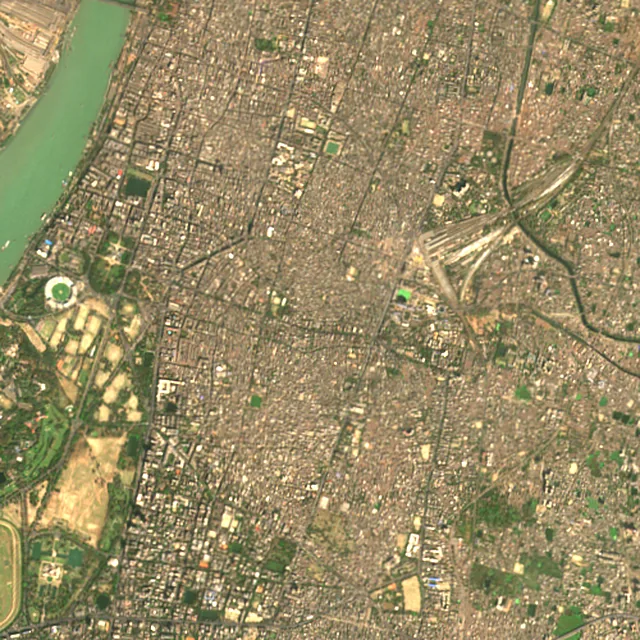
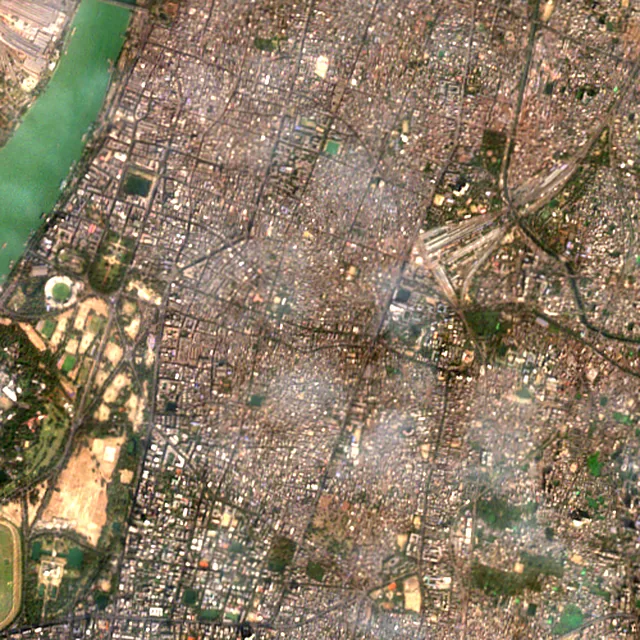

2017: satellite photo from February 2017 of a 5 × 5 km area in the city center.
- Forest lost since 2001
- 2 ha
- Share of its forest
- 1.7%of what there was in 2000
- Cleared for good
- under 1 hadeforestation: turned into farms, mines or towns
Hectares of forest lost each year
Show the figures as a table
| Year | Cleared for good | Can grow back | Total |
|---|---|---|---|
| 2001 | under 1 ha | under 1 ha | under 1 ha |
| 2002 | under 1 ha | under 1 ha | under 1 ha |
| 2003 | under 1 ha | under 1 ha | under 1 ha |
| 2004 | under 1 ha | under 1 ha | under 1 ha |
| 2005 | under 1 ha | under 1 ha | under 1 ha |
| 2006 | under 1 ha | under 1 ha | under 1 ha |
| 2007 | under 1 ha | under 1 ha | under 1 ha |
| 2008 | under 1 ha | under 1 ha | under 1 ha |
| 2009 | under 1 ha | under 1 ha | under 1 ha |
| 2010 | under 1 ha | under 1 ha | under 1 ha |
| 2011 | under 1 ha | under 1 ha | under 1 ha |
| 2012 | under 1 ha | under 1 ha | under 1 ha |
| 2013 | under 1 ha | under 1 ha | under 1 ha |
| 2014 | under 1 ha | under 1 ha | under 1 ha |
| 2015 | under 1 ha | under 1 ha | under 1 ha |
| 2016 | under 1 ha | under 1 ha | under 1 ha |
| 2017 | under 1 ha | under 1 ha | under 1 ha |
| 2018 | under 1 ha | under 1 ha | under 1 ha |
| 2019 | under 1 ha | under 1 ha | under 1 ha |
| 2020 | under 1 ha | under 1 ha | under 1 ha |
| 2021 | under 1 ha | under 1 ha | under 1 ha |
| 2022 | under 1 ha | under 1 ha | under 1 ha |
| 2023 | under 1 ha | under 1 ha | under 1 ha |
| 2024 | under 1 ha | under 1 ha | under 1 ha |
| 2025 | under 1 ha | under 1 ha | under 1 ha |
Forest gained and lost, 2000–2020
- Forest in 2000
- 2,370 ha
- Forest in 2020
- 2,370 ha
- Overall change
- +2 hamore forest than in 2000
Comparing satellite maps from 2000 and 2020, the forest around Kolkata stayed about the same size, at about 2,370 hectares: new forest grew on about 87 hectares, and about 84 hectares were lost.
These 2000 and 2020 maps, from the University of Maryland, count any land with trees taller than 5 m as forest, including plantations and orchards. Forest that was cut or burned and had grown back by 2020 counts in both years, so the loss here is smaller than the yearly figures.
These figures cover everything within 10 km of the city center, a wider area than the report above, because forest is usually lost at a city's edges.
Source: Hansen/UMD/Google/USGS/NASA, Global Forest Change (GFC-2025-v1.13); causes: WRI/Google DeepMind drivers of forest loss; both CC BY 4.0, summed by Airleaf for each area. Forest gained and lost 2000–2020: Potapov et al. 2022, UMD GLAD Global Land Cover and Land Use Change, CC BY 4.0. Images: contains modified Copernicus Sentinel data. How it's measured
In the same region
Measured cities near Kolkata
Same 2 km radius, same index — so they compare directly.
- Maheshtala12.8 km
India
- Tree cover
- 72%
- Air quality
- 90
- Pānihāti14.3 km
India
- Tree cover
- 40%
- Air quality
- 108
- Rajpur Sonarpur15.5 km
India
- Tree cover
- 68%
- Air quality
- 87
- Bārāsat21.5 km
India
- Tree cover
- 53%
- Air quality
- 89
- Bārākpur22.6 km
India
- Tree cover
- 58%
- Air quality
- 83
- Uluberiya28.8 km
India
- Tree cover
- 77%
- Air quality
- 87
Build your own
Compare Kolkata with anywhere
This place
Kolkata
Use this data
Put Kolkata's numbers on your site
Free to embed. Updates itself as the measurement refreshes.

Frequently asked
Questions about Kolkata
What is the air quality (AQI) in Kolkata right now?
The latest reading for Kolkata shows an AQI of 87 (Moderate), measured Nov 11, 20:45 local time by 10 ground monitoring stations via OpenAQ (the median of their readings; the nearest is Fort William, Kolkata - WBPCB, 2.2 km away). The main pollutant is PM2.5. Unusually sensitive people should consider limiting long outdoor exertion.
Is it safe to exercise outside in Kolkata today?
At AQI 87 (Moderate): fine for most people; unusually sensitive people should take long or hard exercise easier. Windows: fine to open; close them if you are sensitive to pollution. Masks: not needed for most people. The reading changes through the day, so check again before a long run or ride.
What has the air quality in Kolkata been like this week?
Over the last 7 days, the CAMS air-quality model put Kolkata's daily AQI at 175 on average, from 128 on Nov 11 to an hourly peak of 246 on Nov 8. On 7 of those days the average was above 100, unhealthy for sensitive groups.
When is air pollution worst in Kolkata?
From October to February. In winter the air near the ground mixes less, winds weaken, and winter winds from the north bring pollution from upwind areas.
What causes Kolkata's winter pollution?
Burning of wood, leaves and rubbish is the key source that makes the city's fine particles more toxic, with vehicles, road dust and industry also adding to the load. Cold, still winter air keeps the pollution close to the ground.
How polluted is Kolkata compared with Delhi?
Less polluted, but still well above India's national standard. In winter 2025-26, fine particle levels averaged 78 µg/m³ in Kolkata and 163 µg/m³ in Delhi, against India's national standard of 40 µg/m³.
Is Kolkata's air getting better?
There are signs of progress. From October 2024 to January 2025, Kolkata had its lowest winter average in four winters, and emissions from vehicles, industry and road dust fell after the National Clean Air Programme began in 2019. Burning of biomass and waste has not fallen in the same way.
Is Kolkata's AQI the same as India's AQI (CPCB)?
No. Airleaf shows the US EPA Air Quality Index (AQI), the scale used by IQAir and most air-quality apps. India's Central Pollution Control Board (CPCB) publishes the National Air Quality Index on its own scale: 0–50 good, 51–100 satisfactory, 101–200 moderate, 201–300 poor, 301–400 very poor and 401–500 severe. The two scales don't line up. At moderate fine-particle levels the US scale reads higher: 55 µg/m³ of PM2.5 is 149 on the US AQI but about 92, "satisfactory", on India's. In heavy smog India's reads higher: 100 µg/m³ is 182 on the US AQI and about 232, "poor", on India's. CPCB also averages particles over 24 hours, so its figure moves more slowly than an hourly reading.
How much forest has the area around Kolkata lost since 2001?
Since 2001, the area within 10 km of Kolkata has lost about 2 hectares of forest: 1.7% of the forest it had in 2000. The satellites couldn't tell what caused most of it. Almost none of it was deforestation, meaning forest cleared for good. Comparing satellite maps from 2000 and 2020, the forest around Kolkata stayed about the same size, at about 2,370 hectares: new forest grew on about 87 hectares, and about 84 hectares were lost.
What is the tree count in Kolkata?
Kolkata has an estimated 89,983 trees across the 12.54 km² of land measured — 28.7% tree cover, 1 percentage points short of the 30% tree-cover target set for this area.
How many more trees does Kolkata need?
Kolkata needs roughly 4,076 more trees to close a 1-point shortfall against its 30% tree-cover target — about 89.7 t of extra CO₂ absorbed per year once grown.
How are Kolkata's air quality and tree cover measured?
Air quality is measured by ground monitoring stations near Lebutala, via OpenAQ; the 7-day trend is the Open-Meteo / CAMS model's estimate. Tree cover is measured from Sentinel-2 L2A (ESA Copernicus) via Earth Search satellite imagery at 10 m detail across a 2 km radius around Lebutala; the tree count is an estimate derived from that cover.
See your own area
What does your neighborhood look like?
Pick any point and radius to get the same air-quality and tree-cover breakdown.
Check my address