Air quality comparison · South Korea, 335 km apart
Busan vs Incheon Air quality index (AQI) today
Busan has cleaner air than Incheon right now: AQI 73 (Moderate) against 88 (Moderate).
Both sit in the same EPA band, so the health advice is the same for each today. Over the past 7 days, on modeled daily averages, Busan averaged AQI 55 against 74, and it was the cleaner of the two on 7 of those days. Busan has lost more forest since 2001. Busan has more tree cover.
Updated . Lower is better on the US EPA index: 0–50 is Good, above 300 is Hazardous. Measured by Airleaf.
Busan73Incheon88
Head to head
Busan vs Incheon at a glance
Busan is ahead on 5 of 6 measures, and Incheon on 1. The better figure in each row is marked.
| Busan | Incheon | |
|---|---|---|
| Air quality nowUS AQI. Lower is better. | 73 (better) | 88 |
| PM2.5Fine particles, µg/m³. | 21 (better) | 29 |
| Past week's averageUS AQI, 7 days. | 55 (better) | 74 |
| Forest lost since 2001Within 10 km of the center. | 91 ha | 23 ha (better) |
| Tree coverWithin 2 km of the center. | 19.6% (better) | 11.7% |
| Trees still neededTo reach a healthy canopy. | 26.3K (better) | 57.5K |
Air quality today
What is the air like in Busan and Incheon right now?
Busan has cleaner air than Incheon right now: AQI 73 (Moderate) against 88 (Moderate). PM2.5 is setting the index in both.
Busan's PM2.5 is about 1.4× the WHO's 24-hour guideline of 15 µg/m³. Incheon's PM2.5 is about 1.9× the WHO's 24-hour guideline of 15 µg/m³.
Both readings come from nearby ground stations.
BusanIncheon
Concentrations at the same moment as the index above, for the pollutants both places report. Lower is better. The dark marks on the PM2.5 and PM10 rows show the WHO's 24-hour guidelines (15 and 45 µg/m³).
Busan: Ground station · 광복동, 200 m away · median of 17 stations. Data: OpenAQ · Korea Air Ministry of Environment, Korea Environment Corporation · AirKorea.
Incheon: Ground station · 주안, 1.1 km away · median of 30 stations. Data: OpenAQ · Korea Air Ministry of Environment, Korea Environment Corporation · AirKorea.
The past week
Which had cleaner air over the past 7 days?
Over the past 7 days, on modeled daily averages, Busan averaged AQI 55 against 74, and it was the cleaner of the two on 7 of those days. A single reading can catch a city on a bad afternoon; the week says whether it was the weather or the place.
- Cleaner days
- Busan7Incheon0
- Average AQI
- Busan55Incheon74
- Worst day, AQI
- Busan74Incheon121
The daily numbers (7 days)
| Day | Busan | Incheon |
|---|---|---|
| Nov 5 | 53 | 92 |
| Nov 6 | 49 | 52 |
| Nov 7 | 47 | 54 |
| Nov 8 | 59 | 68 |
| Nov 9 | 55 | 58 |
| Nov 10 | 47 | 73 |
| Nov 11 | 74 | 121 |
Daily averages from the CAMS atmospheric model for both places, so the week compares like with like. They can differ from today's reading at the top of the page wherever that comes from a ground station.
What it means today
Is it safe to go outside in Busan and Incheon today?
Unusually sensitive people should consider limiting long outdoor exertion. Both are in the same EPA band today (Moderate), so the advice is the same.
Exercise outdoors
Fine for most people; unusually sensitive people should take long or hard exercise easier.
Windows
Fine to open; close them if you are sensitive to pollution.
Masks
Not needed for most people.
Air purifier
Worth running if you are sensitive.
Against everywhere else
How do Busan and Incheon compare with the rest of the world?
Right now Busan's air is cleaner than 35% of the 5,420 places Airleaf tracks, and Incheon's is cleaner than 26%. Within South Korea, that is 67% and 24% of its 56 measured places.
Cleaner air than…
- Busan
- Beats 35%
- Incheon
- Beats 26%
More tree cover than…
- Busan
- Beats 46%
- Incheon
- Beats 26%
Includes model estimates as well as station readings, so it can differ from our most polluted and cleanest air rankings, which use station readings only.
Deforestation · 2001–2025
Which has lost more forest, Busan or Incheon?
Busan has lost more: about 91 ha of forest within 10 km of its center from 2001 to 2025, against 23 ha around Incheon. 74 ha of that was cleared for good, for farms, mines or towns.
Measured within 10 km of each center, from the yearly satellite maps of forest loss: a wider circle than the one for tree cover, because forest is usually lost at a city's edges.
Worst year: 2004, with 18 ha lost.
Worst year: 2006, with 4 ha lost.
| Busan | Incheon | |
|---|---|---|
| Forest lost since 2001Cleared, burned or logged. | 91 ha | 23 ha (better) |
| Share of its forestOf what it had in 2000. | 1.6% (better) | 1.6% |
| Cleared for goodTurned into farms, mines or towns. | 74 ha | 21 ha (better) |
| Recent trend2021–2025 against the five years before. | Too little to call | Too little to call |
| Main known cause | Towns and roads (81%) | Towns and roads (91%) |
Satellite timelapses
Watch both change, year by year
A clear satellite photo a year of the land around each city. Press play, turn on the forest cleared since the first year, or drag the before and after.
Busan
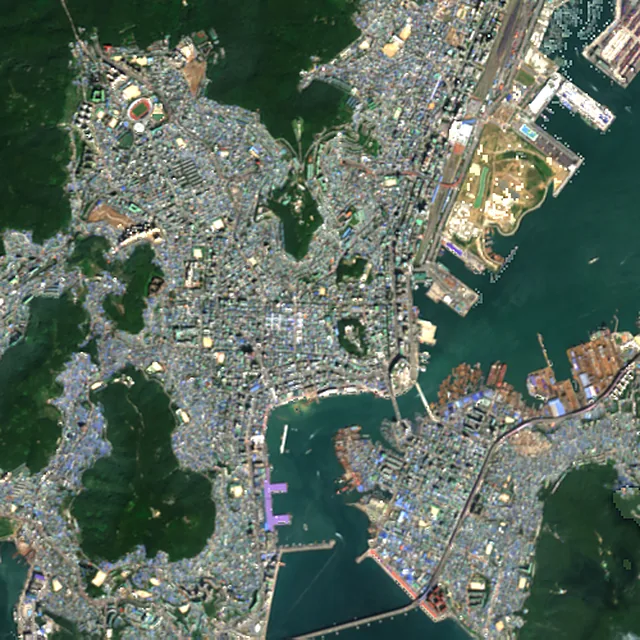
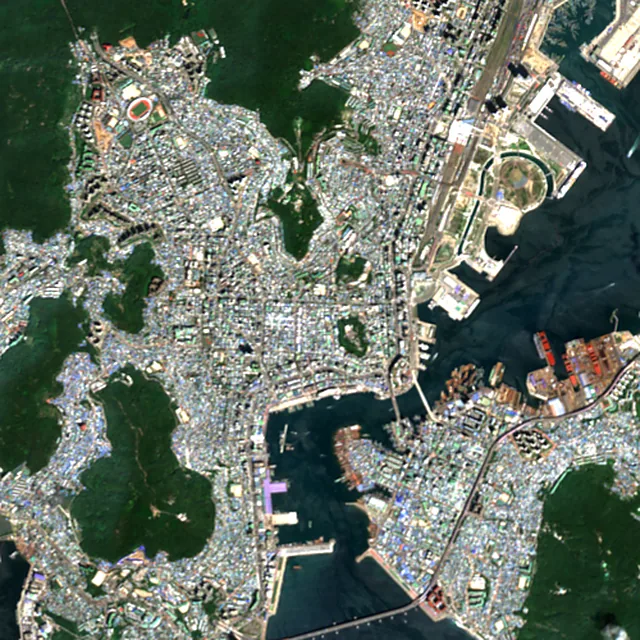

2017: satellite photo from September 2017 of a 5 × 5 km area in the city center.
Incheon
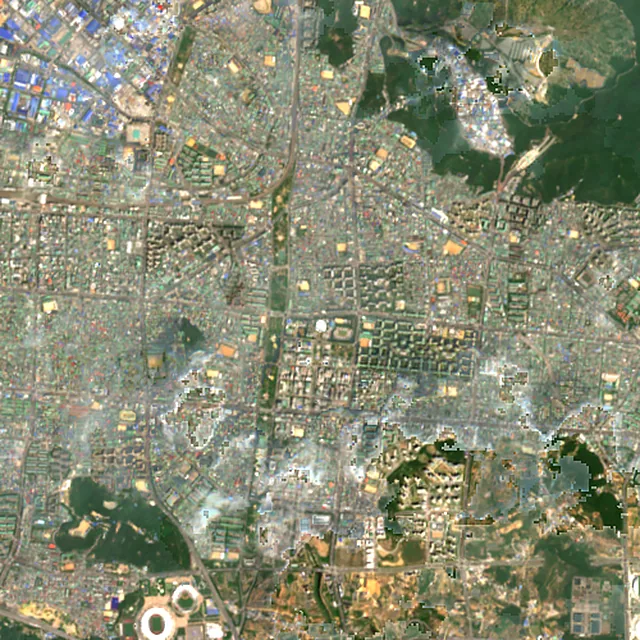
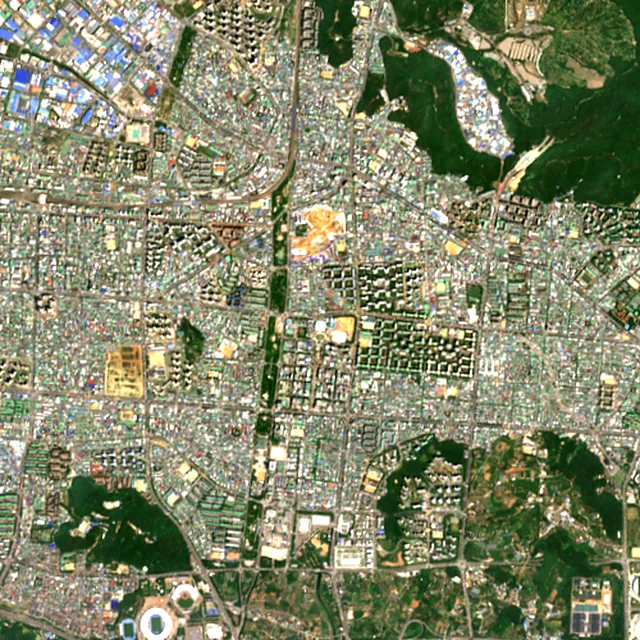

2017: satellite photo from June 2017 of a 5 × 5 km area in the city center.
Trees
Which has more trees, Busan or Incheon?
Busan has more tree cover: 19.6% of the land within 2 km of its center against 11.7% around Incheon, or about 49,568 trees against 36,757.
The dark mark is each place's canopy target: 30% of the land, raised where air quality is poor.
| Busan | Incheon | |
|---|---|---|
| Trees standingEstimated from the canopy area. | 49.6K (better) | 36.8K |
| Trees still neededTo reach the target. Fewer is better. | 26.3K (better) | 57.5K |
| CO₂ absorbed each yearBy the trees already standing. | 1.1M kg (better) | 809K kg |
Tree cover on the satellite image
The same 2 km radius around each center, with the tree cover the satellite found marked on it.
Reading these numbers
How this comparison is made
Air quality index
The US EPA index, computed from current pollutant concentrations: ground stations where a place has them nearby, and the CAMS atmospheric model everywhere else. It moves hour to hour, so it is a snapshot rather than a verdict on either place. The guideline marks are from the WHO's 2021 air quality guidelines.
Trees and forest
Tree cover is the share of ground under canopy within 2 km of each center, read from Sentinel-2 satellite imagery at 10 m detail. It measures that circle, not the whole municipality, which is what makes the two comparable. Forest loss comes from the University of Maryland's Global Forest Change maps.
More on the method on the About Airleaf page.
Frequently asked
Busan vs Incheon: your questions answered
Is Busan cleaner than Incheon?
On air quality, yes, right now: Busan reads AQI 73 against 88, a gap of 15 points on the US EPA index. This is a live reading rather than an annual average, so it can reverse within a day. Over the past 7 days, on modeled daily averages, Busan averaged AQI 55 against 74, and it was the cleaner of the two on 7 of those days.
Is it safe to exercise outdoors in Busan and Incheon today?
The advice is the same for both today. Unusually sensitive people should consider limiting long outdoor exertion. Busan reads AQI 73 and Incheon reads AQI 88.
Which has lost more forest, Busan or Incheon?
Busan has lost more: about 91 ha of forest within 10 km of its center from 2001 to 2025, against 23 ha around Incheon. 74 ha of that was cleared for good, for farms, mines or towns.
Which has more trees, Busan or Incheon?
Busan has more tree cover: 19.6% of the land within 2 km of its center against 11.7% around Incheon, or about 49,568 trees against 36,757. Both figures describe the same-sized circle of ground around each center, not the whole municipality.
How many more trees do Busan and Incheon need?
Busan needs about 26,301 more to reach its canopy target of 30%, and Incheon about 57,491 to reach 30%. The target starts at 30% of the land and rises where air quality is poor.
Are Busan and Incheon measured the same way?
The method is the same: the US EPA index for air, and Sentinel-2 satellite imagery at 10 m detail over an identical radius for trees. Both readings come from nearby ground stations. Nothing is adjusted for population, city limits or climate.
How often does the Busan vs Incheon comparison update?
The air readings refresh about once an hour, and each reading's local time is shown at the top of the page. Tree cover comes from the latest clear satellite image of each area (Sep 12, 2026 and Jun 15, 2026), and the forest figures are published yearly.
Keep going
Compare them with somewhere else
Build your own
Compare Busan with somewhere else
This place
Busan