City report · Kerman, Iran
Rafsanjān Air quality today
Air quality in Rafsanjān currently reads AQI 55 (Moderate): Unusually sensitive people should consider limiting long outdoor exertion.
AQI 55
Air quality right now
Moderate
- PM2.5, fine particles (µg/m³)
- 11.2
- tree cover
- 2.2%
- trees in this area
- 6.9K
- more trees needed
- 87.3K
Measured across a 2 km radius around Rafsanjan, Kerman Province, Iran (12.57 km²), from a satellite image of Sep 24, 2026. Lower AQI is better: 0–50 is Good, above 300 is Hazardous.
Rafsanjān · AQI 55 (Moderate)
Rafsanjān's tree count comes to 6,912 trees across 12.57 km², 28 points below the 30% tree-cover level considered healthy for this area, so roughly 87,336 more trees would close the gap.
Air quality detail
Air quality in Rafsanjān today: AQI 55, Moderate
Main pollutant: PM2.5 · Observed Nov 10, 23:30 local time via Open-Meteo / CAMS, US EPA index. Values in µg/m³.
Model estimate · no ground station nearby
Health signal
Unusually sensitive people should consider limiting long outdoor exertion.
PM2.5
11.2
PM10
19.3
NO₂
25.5
O₃
44.0
SO₂
4.0
CO
191.0
- Outdoor exercise
- Fine for most people; unusually sensitive people should take long or hard exercise easier
- Windows
- Fine to open; close them if you are sensitive to pollution
- Mask
- Not needed for most people
- Air purifier
- Worth running if you are sensitive
Over the last 7 days, the CAMS air-quality model put Rafsanjān's daily AQI at 57 on average, from 49 on Nov 10 to an hourly peak of 97 on Nov 8.
Where Rafsanjān stands: the most polluted cities in the world right now · the cleanest
Tree cover detail
Tree cover in Rafsanjān: Critically low
2.2% tree cover against a 30% healthy-neighborhood target, across 12.57 km².
Trees in this area
6,912
Target trees
94,248
More trees needed
87,336
CO₂ if planted / yr
1,921 t
Deforestation · 2001–2025
How much forest has Rafsanjān lost?
There was almost no forest around Rafsanjān in 2000, so there has been almost nothing to lose since. Only fairly dense woodland counts as forest in these maps, so scattered street and garden trees don't show up here.
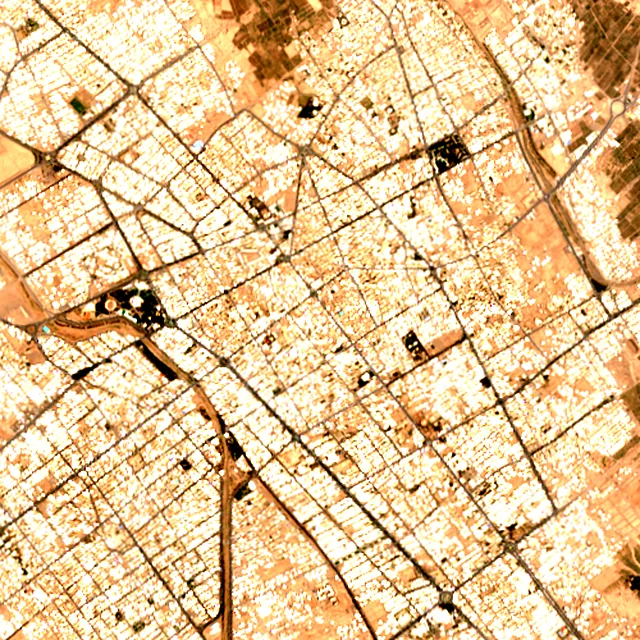
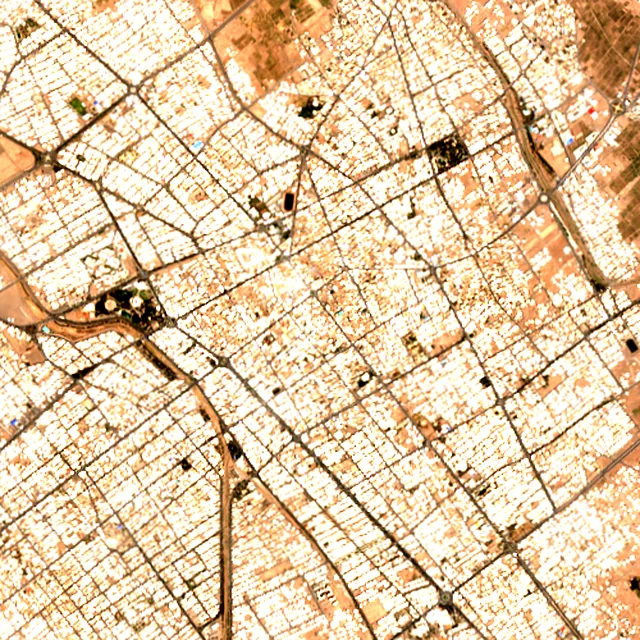
2018: satellite photo from June 2018 of a 5 × 5 km area in the city center.
These figures cover everything within 10 km of the city center, a wider area than the report above, because forest is usually lost at a city's edges.
Source: Hansen/UMD/Google/USGS/NASA, Global Forest Change (GFC-2025-v1.13); causes: WRI/Google DeepMind drivers of forest loss; both CC BY 4.0, summed by Airleaf for each area. Images: contains modified Copernicus Sentinel data. How it's measured
In the same region
Measured cities near Rafsanjān
Same 2 km radius, same index — so they compare directly.
Build your own
Compare Rafsanjān with anywhere
This place
Rafsanjān
Use this data
Put Rafsanjān's numbers on your site
Free to embed. Updates itself as the measurement refreshes.
Frequently asked
Questions about Rafsanjān
What is the air quality (AQI) in Rafsanjān right now?
The latest reading for Rafsanjān shows an AQI of 55 (Moderate), observed Nov 10, 23:30 local time via Open-Meteo / CAMS, US EPA index. The main pollutant is PM2.5. Unusually sensitive people should consider limiting long outdoor exertion.
Is it safe to exercise outside in Rafsanjān today?
At AQI 55 (Moderate): fine for most people; unusually sensitive people should take long or hard exercise easier. Windows: fine to open; close them if you are sensitive to pollution. Masks: not needed for most people. The reading changes through the day, so check again before a long run or ride.
What has the air quality in Rafsanjān been like this week?
Over the last 7 days, the CAMS air-quality model put Rafsanjān's daily AQI at 57 on average, from 49 on Nov 10 to an hourly peak of 97 on Nov 8. No day averaged above 100, the level where the air turns unhealthy for sensitive groups.
How much forest has the area around Rafsanjān lost since 2001?
There was almost no forest around Rafsanjān in 2000, so there has been almost nothing to lose since. Only fairly dense woodland counts as forest in these maps, so scattered street and garden trees don't show up here.
What is the tree count in Rafsanjān?
Rafsanjān has an estimated 6,912 trees across the 12.57 km² measured — 2.2% tree cover, 28 percentage points short of the 30% tree-cover target set for this area.
How many more trees does Rafsanjān need?
Rafsanjān needs roughly 87,336 more trees to close a 28-point shortfall against its 30% tree-cover target — about 1,921 t of extra CO₂ absorbed per year once grown.
How are Rafsanjān's air quality and tree cover measured?
Air quality comes from ground monitoring stations via OpenAQ where one reports nearby, and otherwise, as here, from the Open-Meteo / CAMS model, which may differ from street-level monitors. Tree cover is measured from Sentinel-2 L2A (ESA Copernicus) via Earth Search satellite imagery at 10 m detail across a 2 km radius around Rafsanjan; the tree count is an estimate derived from that cover.
See your own area
What does your neighborhood look like?
Pick any point and radius to get the same air-quality and tree-cover breakdown.
Check my address